a time to grieve; a time to dance

Have you ever found a glistening coin on the bed of a flowing stream? You point at it but your friend isn't quite able to see it. Or maybe your friend is pointing at something at a short distance and, for all your neck-craning, you can't quite see what it is.

This blog is exactly that. This is me pointing at something that I know is there and hope you'd see, too. Whether it's at a golden mask at the bottom of the well or an eagle soaring high in the sky, I wish you Happy Looking!
Showing posts with label writing practice. Show all posts

23 September 2012

How King beats the Censor

I am reading Stephen King's On Writing, his treatise on writing fiction. I highly recommend it to everyone, writers and non-writers alike, because it's very entertaining. King is witty and humorous here, a side we don't see in his novels of the dark and macabre.

On Writing gives you insight into the mind of one of the most successful novelists of our time.

I also suspect that what he says about writing can be applied, with personal and intelligent adjustment, to one's own current career.

Here's a quote from the book:

With the door shut, downloading what’s in my head directly to the page, I write as fast as I can and still remain comfortable. Writing fiction, especially a long work of fiction, can be a difficult, lonely job; it’s like crossing the Atlantic
Ocean in a bathtub. There’s plenty of opportunity for selfdoubt. If I write rapidly, putting down my story exactly as it comes into my mind, only looking back to check the names of my characters and the relevant parts of their back stories, I find that I can keep up with my original enthusiasm and at the same time outrun the self-doubt that’s always waiting to settle in.

This is the same trick that Natalie Goldberg, poet, painter, and author of Banana Rose employs. Write fast! Do your writing practice and write faster than your Internal Editor can catch up with you. Don't think too much, Nat says, in her rules for writing practice:

1. Keep your hand moving.
When you sit down to write, whether it’s for ten minutes or an hour, once you begin, don’t stop. If an atom bomb drops at your feet eight minutes after you have begun and you were going to write for ten minutes, don’t budge. You’ll go out writing.

2. Lose control.
Say what you want to say. Don’t worry if it’s correct, polite, appropriate. Just let it rip.

3. Be specific.
Not car, but Cadillac. Not fruit, but apple. Not bird, but wren. Not a codependent, neurotic man, but Harry, who runs to open the refrigerator for his wife, thinking she wants an apple, when she’s headed for the gas stove to light her cigarette. Be careful of those pop-psychology labels. Get below the label and be specific to the person.

4. Don’t think.
We usually live in the realm of second or third thoughts, thoughts on thoughts, rather than in the realm of first thoughts, the real way we flash on something. Stay with the first flash.

5. Don’t worry about punctuation, spelling, grammar.

6. You are free to write the worst junk ever.

7. Go for the jugular.
If something scary comes up, go for it. That’s where the energy is. Otherwise, you’ll spend all your time writing around whatever makes you nervous.

Creativity guru Julia Cameron has written lots of books on creativity. In these books she showers you with hundreds of exercises for examination and self-discovery. She also prescribes the same formula. Write fast.

So you have a story or an idea of a story in your head right now. This essay ends here. Go! Write! Do it fast! Burn through to original thoughts.

05 January 2012

A chronological Bible study guide I return to

There are many ways to read through the Holy Bible and one that I personally favor is a chronological study. That means you don't read the book from Genesis to Revelation, going through the books as they are listed in the Table of Contents. (I tried to do that when I was in 5th Grade. When I came to the Chronicles I read about events that were already described in Kings. I thought, "Oh. History repeats itself.")

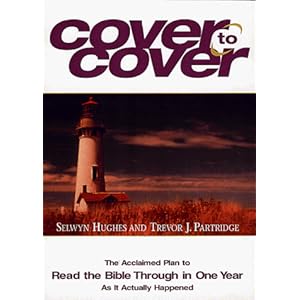
Selwin Hughes and Trevor J. Partridge's Cover to Cover: The acclaimed plan to read the Bible through in one year as it actually happened has helped me read through the Bible once years ago. I plan to go through it again, this time in a slower pace, not compulsively speeding through the day's prescribed reading, but conscientiously chewing and digesting God's words as I go.

So, I begin not on 1 January 2012 but several days late, and I try to mull on the pages. I hit upon an idea. Read the Bible. Stop when a passage or verse jumps at me. Go to my notebook and dive deep into a timed writing practice.

I haven't exactly been able to do that, but tonight, since Veck and Dana are on a much belated vacation trip to the in-laws in Malolos, I am going to BGC hours earlier than my work shift to do just that. I've some chores to do (bring the Blackberry to the store for needed repairs, pick up a book order, etc.) that I really need to get going.

Finally, here I am, opening to page one of the daily reading plan.There is a slight dread. I've read every word of the Bible before. Is there anything new I will find? Shall I switch to a different version for a fresher perspective? The King James Version, maybe, and reconstruct my English syntax? I might walk around the office and ask people, "Where art thou having supper?" or recite "Thy payment shalt be applied unto thy account within two to-morrows of to-day." That would be a riot. I was not exactly looking forward to reading the Bible.

Then bam! Right there, I see something I missed when I first went through. Hughes and Partridge cover not just Creation on Day 1, but also Satan's pride and fall (Isaiah 14:12-17; Ezekiel 28:13-19). That's what got me racing to my notebook. So early on, at the onset of 2012, God is warning me of the danger of pride. I better take heed.

Pride is when I convince myself I don't need God and do things my way. That my ways are better. That I'm always right. Nothing can be further from the truth. I am helpless, vulnerable, doomed and in desperate need of a Savior. Pride blinds me to that truth.

So I list the ways I can be full of pride.

"I already know this" ... when listening to a Sunday sermon.
"Some people are born slow so I'll just need to be patient" ... when people or colleagues seem to not get what I am trying to say.
"I can't be wrong" ... when someone disagrees with me.
"It's not my fault" ... when convicted of sin, or when Veck tells me how I can be a better husband and father.
"Let's try it my way" ... when God shows me the right path to take.
"Maybe later" ... when God tells me to do something.

The list goes on.

I bring this list to Jesus and wonder what He'll do with it. I suspect He'll put a blood-colored stamp mark on it: "Already Taken Care Of 2000 Years Ago."

O Jesus, I need a Savior! I need a King! I need You.